How to Choose the Best China Aluminum Bathroom Door?

Time:2026-10-05 Author:Sienna
0%

Choosing the best China aluminum bathroom door requires more than comparing prices and surface finishes. A reliable decision begins with the bathroom’s actual conditions. Measure the opening, wall thickness, floor level, and available swing space before contacting a supplier. In real renovation projects, a door that looks perfect online may clash with a raised threshold or uneven tile.

An Aluminum Bathroom Door should balance moisture resistance, structural strength, appearance, and daily comfort. Check the aluminum alloy, frame thickness, coating process, hinge quality, and locking system. Powder coating can provide a clean finish, but its durability depends on preparation and application. Ask for material specifications, production photos, test information, and clear warranty terms. Small details matter. A weak seal or poorly aligned hinge can cause noise, water marks, and repeated adjustments.

China has many capable door manufacturers, yet quality varies between factories. Factory experience, inspection procedures, customization ability, and communication deserve careful review. Request a sample before placing a large order, especially when the project includes unusual dimensions or glass panels. Confirm packaging methods and delivery responsibilities in writing. This step feels slow, but it can prevent expensive surprises.

The best supplier is not always the cheapest one. It should explain limitations honestly and recommend suitable options without pressure. Still, no checklist replaces practical judgment. Review the product after installation, because real performance may reveal details that brochures miss. This guide explores the key questions, technical features, and supplier checks that support a more confident purchase.
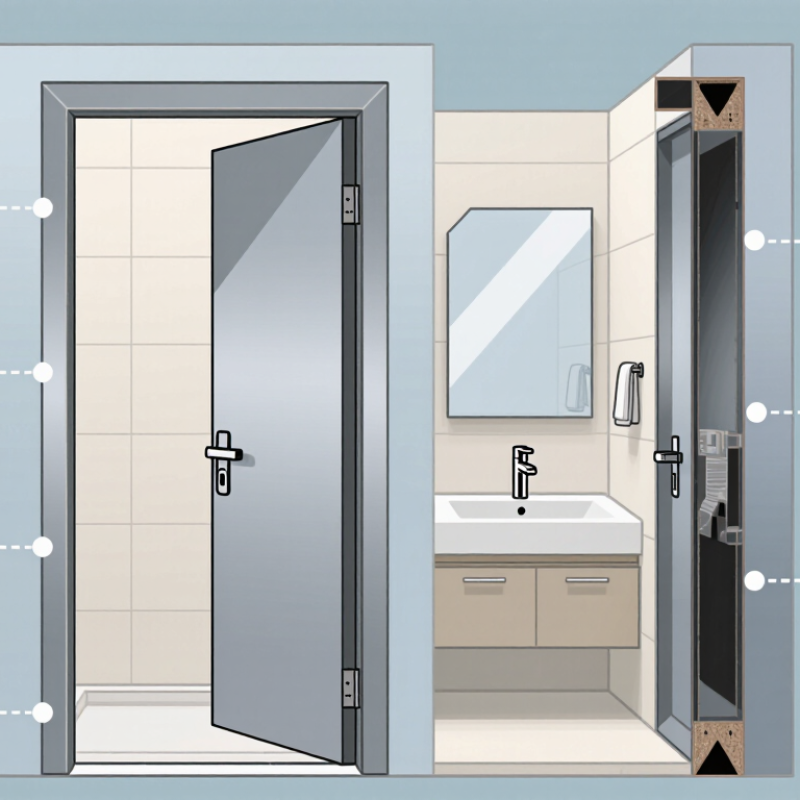
How to Choose the Best China Aluminum Bathroom Door?

Define Your Bathroom Door Requirements and Installation Space

Choosing the best China aluminum bathroom door begins with the installation space, not the appearance. Measure the opening at three points: top, middle, and bottom. Record the smallest width. Check the wall thickness, ceiling height, floor level, and nearby fixtures. A door may fit the opening but still hit a toilet, basin, or towel rail.

Decide how the door should operate. A sliding door needs clear wall space and a strong, level track. A hinged door needs enough swing clearance and a stable frame. I once focused too much on the panel design and overlooked an uneven floor. The result was poor sealing. Small details matter. Consider wet and dry zones, drainage direction, ventilation, privacy, and cleaning access. For bathrooms with frequent water exposure, ask for corrosion-resistant aluminum and suitable safety glass.

Share accurate measurements, photos, and a simple installation drawing with the supplier. Request written details for frame dimensions, glass thickness, hardware, surface finish, seals, and adjustment range. Confirm whether the supplied size includes the frame. It often does not. Ask for installation instructions and check local building requirements before ordering. A physical sample can reveal color differences, sharp edges, weak seals, or awkward handles that drawings cannot show. Do not ignore these findings. Reconsider the design if maintenance looks difficult.

Compare Aluminum Grades, Profiles, and Surface Treatments

How to Choose the Best China Aluminum Bathroom Door?

Start with the alloy, not the color. 6063-T5 is widely used for door frames because it extrudes smoothly and offers clean, detailed profiles. 6061 provides higher strength, but it can cost more and appear less refined after extrusion. For wet interiors, ask for the alloy designation, temper, wall thickness, and mill certificate. A glossy sample proves little.

Profile design controls daily performance. A well-designed frame should resist twisting, hold hinges firmly, and drain water away from the threshold. I prefer reinforced hinge zones and accurately fitted EPDM seals. Thin profiles may look modern, but they can flex under repeated use. China’s national building-material testing framework and ISO 7599 both support checking dimensional accuracy and anodized coating quality. Still, test results need matching production samples.

Surface treatment deserves close attention. Anodizing creates a hard oxide layer and suits minimalist interiors. Powder coating offers broader colors and can hide small extrusion marks. For demanding environments, compare coating specifications with AAMA 2603, 2604, or 2605, rather than trusting “high quality” wording. The International Aluminium Institute reports that recycled aluminum requires about 5% of the energy used for primary aluminum production. That supports recycled content, but traceability remains uneven. I would not accept a recycled-content claim without supplier records. Also, salt-spray hours are not a complete prediction of bathroom life. Condensation, cleaning chemicals, and poor drainage still expose weaknesses.

Evaluate Door Styles, Glass Options, and Functional Features

How to Choose the Best China Aluminum Bathroom Door?

Door style should match the bathroom layout, not only its appearance. Hinged doors offer a wide opening and simple cleaning, but they need clear floor space. Sliding doors suit compact rooms, although their tracks can collect hair, soap, and moisture. Folding doors save space, yet their hinges require more careful alignment. Measure the opening after wall tiles are installed. A few millimeters can change the fit.

Glass affects privacy, brightness, and safety. Clear tempered glass makes a small bathroom feel larger, while frosted or patterned glass offers better privacy. Tempered glass should meet recognized safety requirements and have smooth, polished edges. Thicker glass often feels more stable, but it also increases weight and hardware demands. In my experience, attractive glass is not always practical; heavy water marks can make clear panels frustrating to maintain. Think about cleaning habits.

Tips: Check the aluminum profile thickness, surface finish, hinge quality, and bottom seal. Ask for corrosion-resistance information, especially for coastal or humid areas. A magnetic latch should close firmly without slamming. The door should open freely and leave enough space for towels and movement. Strong sealing helps prevent splashes, but complete sealing may reduce ventilation. That trade-off deserves attention. Inspect the frame corners and drainage path before ordering, because small design details often decide long-term reliability.

Check Quality Standards, Safety, Hardware, and Weather Resistance

Choosing a China aluminum bathroom door requires more than comparing photos and prices. Check the alloy grade, frame thickness, weld quality, and surface finish. Ask for traceable test reports, not vague claims about “premium quality.” Confirm that measurements follow the project’s local building requirements. A reliable supplier should explain tolerances clearly.

Safety deserves close attention. Choose corrosion-resistant hinges, secure handles, and smooth, accurately aligned rollers. For glazed doors, verify suitable tempered or laminated glass and safe edge finishing. The door should close firmly without trapping fingers. Check the threshold, drainage path, and ventilation gap. Small details matter.

Bathrooms create constant humidity, splashing water, cleaning chemicals, and temperature changes. Look for powder coating or anodizing designed for wet environments. Request evidence of humidity, adhesion, and salt-spray testing when the property is near the coast. Stainless steel 304 hardware may suit many interiors, while 316 can offer better resistance in salty air. Weather resistance is not just about rain; ultraviolet exposure can fade weak coatings.

Do not trust appearance alone. A bright sample may conceal poor internal joints. I once gave too much attention to color and too little to hinge movement; that was a useful mistake. Open and close the actual sample repeatedly. Inspect corners, seals, screw points, and packaging before approval. Reliable records, responsive answers, and consistent samples are strong signs of professional manufacturing.

How to Choose the Best China Aluminum Bathroom Door?

Quality standards, safety, hardware, and weather resistance checklist

The chart uses a practical 100-point purchasing framework: quality standards receive 30%, safety 25%, hardware 20%, and weather resistance 25%. Ask suppliers for relevant test reports, including EN 12150 for thermally toughened safety glass, EN 12207 for air permeability, EN 12208 for watertightness, and EN 12210 for resistance to wind load where applicable. Hardware should be checked for corrosion-resistant materials, secure locking, smooth operation, and replaceable components.

Assess Suppliers, Customization Services, Pricing, and After-Sales Support

How to Choose the Best China Aluminum Bathroom Door?

Supplier evaluation should begin with evidence, not attractive photographs. Request aluminum alloy details, profile thickness, coating specifications, and hardware samples. A reliable supplier should provide factory records, quality procedures, and compliance documents for your destination market. Ask for recent project references, production capacity, and realistic lead times. Video inspections can help, but an independent factory audit gives stronger assurance.

Tips: Compare identical specifications. Check frame thickness, glass type, finish, hinges, packaging, and delivery terms. Ask whether replacement rollers, seals, and handles remain available after installation. Pricing often changes with design details. A low quotation may exclude packaging, tooling, inspection, or shipping costs. Create a written cost sheet before comparing suppliers. I have seen buyers focus on the unit price and overlook damaged-goods risks. That mistake is expensive.

Customization should include opening direction, dimensions, colors, ventilation features, and privacy glass. Confirm drawings before production begins. A sample door can reveal uneven gaps, weak magnetic seals, or rough coating edges. These small defects matter in a humid bathroom. After-sales support needs clear response times, warranty coverage, spare-part procedures, and installation guidance. Ask how claims are documented and resolved. Good support is practical, not merely polite. Sometimes, communication still fails despite careful planning. Confirm every important detail in writing.

How to Choose the Best China Aluminum Bathroom Door? - Assess Suppliers, Customization Services, Pricing, and After-Sales Support

Assessment Dimension Recommended Benchmark What to Verify Before Ordering Importance Common Warning Signs
Aluminum Material Aluminum profiles such as 6063-T5 or an equivalent architectural-grade alloy are commonly suitable for bathroom doors because they offer good corrosion resistance and machinability. Request the profile specification, wall thickness, alloy or temper information, and a cross-sectional drawing. Confirm that the frame is not made from thin decorative material only. High The supplier cannot provide profile drawings, material details, or a consistent explanation of the frame construction.
Surface Finish Powder coating or anodizing should provide an even appearance and suitable resistance to moisture. Powder-coated finishes are commonly available in multiple colors and textures. Ask for finish samples, coating thickness data where available, color reference information, and cleaning instructions. Check corners, cut edges, and contact areas for exposed aluminum. High Uneven color, visible orange peel, poor coverage around corners, or no sample approval process before mass production.
Glass and Safety Tempered safety glass is commonly used for bathroom doors. Typical residential thicknesses are approximately 6–10 mm, depending on door size, frame design, and local requirements. Confirm glass type, thickness, edge treatment, safety markings, allowable size range, and whether the glass is supplied with a test report applicable to the destination market. High The quotation says only “clear glass” without identifying whether it is tempered, laminated, or otherwise safety-rated.
Water Management A bathroom door should use compatible seals, a properly fitted threshold or bottom sweep, and accurately aligned joints. Water resistance depends on the complete installation, not the frame alone. Request section drawings, seal material information, drainage details, installation tolerances, and test conditions if a water-resistance claim is made. High The supplier guarantees “100% waterproof” without specifying test conditions, installation requirements, or maintenance limitations.
Hardware Quality Stainless steel 304 hardware is widely used for normal indoor bathroom conditions. Stainless steel 316 may be preferable for coastal or high-chloride environments. Verify hinges, handles, rollers, screws, locks, and fasteners separately. Ask whether replacement hardware can be purchased after installation. High Hardware is described only as “metal,” or the supplier substitutes components without written approval.
Customization Capability A capable supplier should support custom dimensions, opening direction, glass options, colors, hardware finishes, packaging marks, and installation requirements. Confirm maximum and minimum dimensions, tolerance limits, available finishes, sample charges, drawing approval procedures, and whether custom tooling is required. High Custom requests are accepted verbally but are not included in the approved drawing or purchase order.
Technical Drawings A complete order should include approved production drawings showing overall dimensions, frame sections, glass position, hardware locations, swing direction, and installation clearances. Require a final drawing signed or electronically approved by both parties before production. Check all dimensions against the actual bathroom opening. High Production starts from informal messages, showroom images, or measurements that have not been formally approved.
Indicative Pricing For a basic standard-size aluminum bathroom door, indicative China export pricing can commonly fall around USD 80–180 per unit. More customized framed glass systems may be approximately USD 180–450 or more. Compare the same specification: dimensions, aluminum profile, glass thickness, hardware, finish, packaging, quantity, trade term, and destination charges. High A very low price excludes glass, hardware, packaging, tooling, inspection, export charges, or other essential components.
Minimum Order Quantity Standard products may be available in small quantities, while custom colors, packaging, or tooling can increase the minimum order. A practical custom-order range is often approximately 10–50 units, but it varies by configuration. Ask for the MOQ by model and by finish. Confirm whether mixed sizes or colors can be combined within one order. Medium The supplier discloses the MOQ only after receiving payment or applies an unexpected small-order surcharge.
Production Lead Time Standard products commonly require approximately 15–30 days after confirmation and deposit. Custom orders often require about 25–45 days, excluding shipping and approval delays. Request a written schedule covering drawing approval, sample production, mass production, inspection, and dispatch. Confirm the effect of holidays and raw-material delays. High The supplier promises an unusually short delivery time without checking material availability or customization requirements.
Quality Control A useful inspection plan should cover dimensions, profile finish, glass condition, hardware operation, door alignment, seal continuity, packaging, and quantity. Ask for pre-production, in-process, and final inspection procedures. For larger orders, consider an independent pre-shipment inspection based on an agreed checklist. High Quality control consists only of photographs taken by the supplier, with no measurable acceptance criteria.
Packaging and Shipping Bathroom doors should be protected against glass breakage, corner impact, abrasion, moisture, and movement during transport. Export packaging often includes protective film, corner protection, cartons, and reinforced pallets or crates. Request packaging photographs and confirm carton dimensions, gross weight, palletization, markings, spare parts, and responsibility for damage claims under the selected trade term. High Glass and frames are packed together without separation, impact protection, moisture protection, or clear identification labels.
Payment Terms A commonly used structure for new international orders is a deposit before production and the balance after inspection or before shipment. Exact terms depend on supplier history and order size. Ensure the contract defines payment milestones, inspection rights, refund conditions, bank-account verification, and the documents required before balance payment. High The supplier requests full payment before drawings, samples, production evidence, or inspection arrangements are completed.
Warranty Coverage A written warranty of approximately 1–5 years may be offered depending on the product and component. Glass breakage caused by impact, incorrect installation, and normal wear are commonly excluded. Review coverage for frames, finish, seals, hinges, rollers, locks, and manufacturing defects. Confirm the claim period, evidence requirements, and remedy options. High The warranty is described as “lifetime” but has no written terms, exclusions, response time, or replacement procedure.
After-Sales Support A reliable support process should provide installation guidance, spare-part availability, troubleshooting instructions, and a defined response target for quality claims. Ask who handles claims, how quickly an acknowledgement is provided, whether replacement parts are stocked, and whether technical support is available in English. High The supplier has no claim form, spare-parts list, technical manual, or named contact for post-delivery issues.
Compliance Documents Documentation should match the destination market and product specification. Possible documents include material declarations, glass safety reports, finish information, packing lists, and commercial invoices. Ask for documents before placing the order and verify that the report model, dimensions, glass type, and supplier information correspond to the supplied product. Medium The supplier sends generic certificates that do not identify the product configuration or destination-market requirements.
Supplier Evaluation Score Use a weighted score before comparing quotations: quality and safety 30%, customization and engineering 20%, total cost 20%, delivery and logistics 15%, warranty and after-sales support 15%. Score at least three quotations using identical specifications. Keep all assumptions, exclusions, samples, drawings, and communication records with the comparison sheet. High The decision is based only on the lowest unit price while ignoring material quality, installation risk, lead time, and replacement support.

Pricing note: The price ranges and lead times shown are indicative industry benchmarks, not fixed quotations. Actual costs depend on door dimensions, glass configuration, hardware, finish, order quantity, packaging, trade terms, inspection, and destination.

FAQS

Which aluminum alloy is suitable for a bathroom door frame?

6063-T5 is commonly suitable because it extrudes smoothly and creates clean profiles. 6061 offers greater strength but may cost more. Ask for the alloy, temper, wall thickness, and mill certificate. Color proves little.

How does profile design affect bathroom door performance?

Strong profiles resist twisting and keep hinges secure during repeated use. Reinforced hinge areas can reduce movement. Accurately fitted seals help prevent leaks. Thin frames may flex.

Which surface treatment works best in humid bathrooms?

Anodizing provides a hard oxide layer and suits simple, modern interiors. Powder coating offers more colors and can hide minor extrusion marks. Request coating specifications and test records. Do not trust vague quality claims.

What quality documents should a supplier provide?

Request traceable test reports, production samples, dimensional records, and material certificates. The documents should match the actual shipment. Check stated tolerances carefully. Records matter.

What hardware details should buyers inspect?

Choose corrosion-resistant hinges, secure handles, and smoothly aligned rollers. Stainless steel hardware may suit ordinary bathrooms. More corrosion-resistant grades can help near salty air. Inspect every screw point.

How should glazed bathroom doors be checked for safety?

Verify suitable tempered or laminated glass with safely finished edges. The door should close firmly without trapping fingers. Check alignment, handle security, and glass edges on the physical sample. Look closely.

Can salt-spray testing predict bathroom durability?

Salt-spray hours offer useful evidence, but they do not predict every bathroom condition. Condensation, cleaning chemicals, poor drainage, and temperature changes can still cause damage. Ask for humidity, adhesion, and coating test results. Testing is not everything.

What should buyers inspect before approving a door sample?

Open and close the sample repeatedly. Check corners, seals, hinge movement, drainage paths, ventilation gaps, and packaging. A bright finish can conceal weak joints. I once focused too much on color. That was a useful mistake.

Is recycled aluminum a reliable sustainability choice?

Recycled aluminum generally requires much less energy than primary aluminum. However, recycled-content claims need supplier records and traceable evidence. Availability and documentation can be uneven. Ask for proof.

Conclusion

Choosing the best China Aluminum Bathroom Door starts with understanding your bathroom’s layout, available opening, ventilation needs, and installation conditions. Measure the space carefully and decide whether a sliding, hinged, folding, or pivot design will provide the most convenient access. Compare aluminum grades, frame thickness, profile structure, and surface treatments to ensure the door offers strength, corrosion resistance, and a clean appearance in a humid environment. Glass selection is equally important, with options such as clear, frosted, patterned, or tempered glass providing different levels of privacy, light, and safety.

A reliable Aluminum Bathroom Door should include durable hardware, secure seals, smooth operation, and finishes that resist moisture and daily wear. Check applicable quality and safety standards, production consistency, packaging, and inspection procedures before ordering. Finally, evaluate the supplier’s customization capabilities, color and size options, pricing transparency, delivery arrangements, warranty terms, and after-sales support. A careful comparison of these factors will help you select a practical, attractive, and long-lasting bathroom door.

Sienna

Sienna

Sienna is a skilled marketing professional with a deep expertise in our company’s core products and services. With a passion for innovation and detail, she plays a pivotal role in crafting insightful blog posts that not only highlight the unique features of our offerings but also provide valuable......